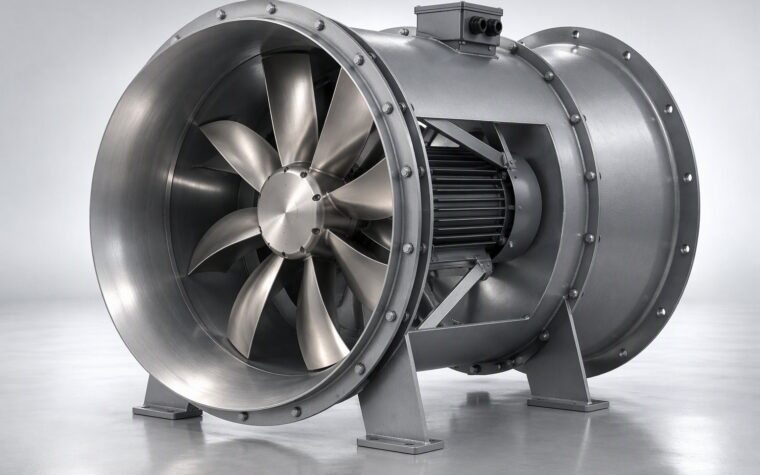
Axial Flow Fan
Straight-through air at low pressure: tube axial, vane axial and propeller builds in mild steel and aluminium.
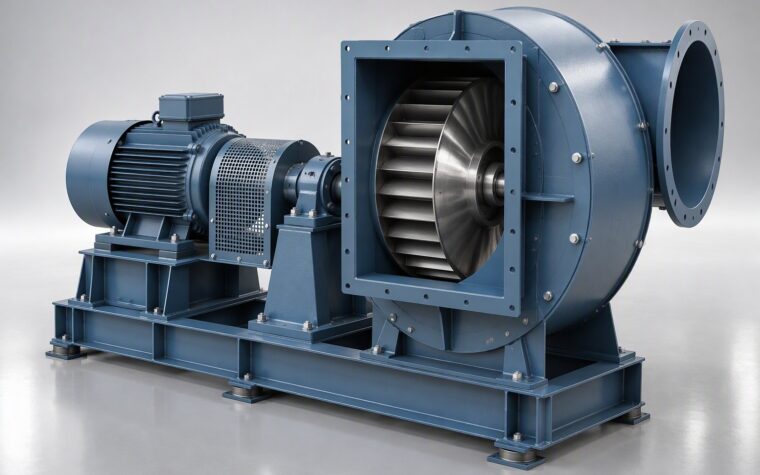
Centrifugal exhauster - air handling
The high-volume end of the centrifugal range. Same physics as a blower, bigger passages, and a materials list that goes from mild steel to titanium because the gas is often neither clean nor ambient.

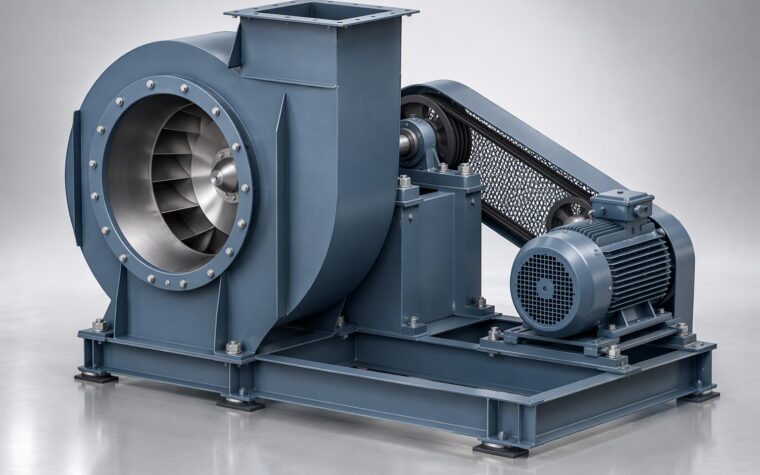
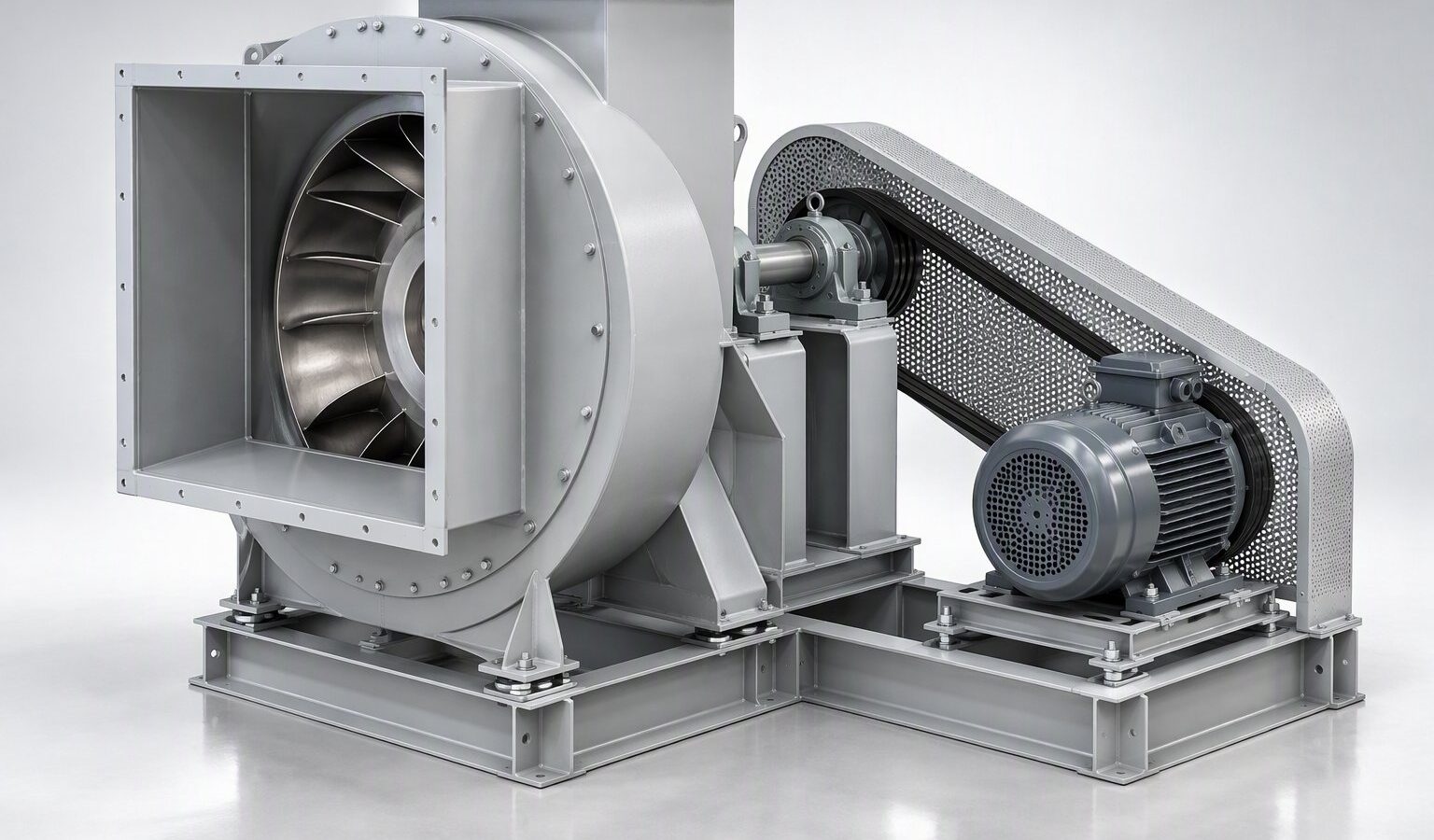
Illustrative 3D render of a representative air handling exhauster build, not a photograph of a shipped unit.
Ranges are the family envelope our own product pages publish. The order always confirms against an approved GA drawing with the duty point, speed and absorbed power for your installation.
Selection logic
An air handling exhauster is chosen on the top axis of the fan curve: it has to move a great deal of gas against a moderate resistance. Our published envelope for the type is 1,750 to 2,30,000 CMH at 1 to 16 inWC static, which is about 25 to 406 mmWC, with gas to 200 C. Where the requirement is above that pressure, the radial families take over.
The other reason this family exists as its own page is materials. A plant exhaust that has passed through a scrubber is not air. It is a warm, wet chemical mixture, and mild steel has a short life in it. We build these in SS 304/304L, SS 316/316L, Duplex 2205, FRP and titanium, and we will pick the grade against your gas analysis rather than your budget line.
Build
Duty fit
Automotive and paint shop exhaust, cement plant ventilation, chemical scrubber service, power plant auxiliary air, pharmaceutical and food clean air, large building and tunnel ventilation, and bag filter clean-side exhaust where the fan sees filtered gas rather than the dirty side.
Single inlet is standard. Double inlet is where this family earns its size: the same wheel diameter passes nearly twice the volume at a lower tip speed, which is quieter and often lets a smaller motor do the work. DWDI is confirmed at enquiry because it changes the casing, the shaft and the foundation.
Range
| Parameter | Industrial Exhauster Air Handling Blower | Industrial Exhauster Radial Shrouded Blower | Backward Curved Blower |
|---|---|---|---|
| Airflow | 1,750 to 2,30,000 CMH | 400 to 1,50,000 CMH | 14,000 to 7,50,000 CMH |
| Static pressure | 25 to 406 mmWC (published as 1 to 16 inWC) | 100 to 2,000 mmWC | 40 to 2,000 mmWC |
| Gas temperature | Up to 200 C | Up to 200 C on this build; higher tiers by arrangement | Up to 200 C |
| Impeller / frame | Impeller 250 to 2,200 mm (range-wide) | Impeller 250 to 2,200 mm (range-wide) | Impeller 250 to 2,200 mm (range-wide) |
Blank cells mean the figure is not published for that family — ask us and we will confirm it against your duty.
Questions
In our range the labels follow the job: blower usually means process air or pressure duty, exhauster means moving large volumes of plant or flue gas, often dirty or corrosive. The machine is the same family; the casing, materials and maintenance access are what change.
When the gas analysis says so – chlorides, fluorides, wet acid carryover. We will show you the corrosion reasoning on the quotation rather than sell you a material grade you do not need.
Casing size is a logistics question, not a design limit. Large housings go out in sections with a field-welding and bolt-up sequence on the drawing.
Airflow and pressure are always quoted at the actual gas density. Altitude, temperature and duct losses move the number — run it through the worksheet before you send it.
Straight-through air at low pressure: tube axial, vane axial and propeller builds in mild steel and aluminium.
High static efficiency, non-overloading power curve. The default wheel for clean and lightly loaded air at medium to high pressure.
Flat plates set at an angle: robust, tolerant of moderate dust, still efficient and still non-overloading.
Enquiry
Tell us the duty and the constraints. You get a selection, a build sheet and a price from the works — not a call centre.