Centrifugal blower - backward inclined wheel

Backward Inclined Blower

The industrial compromise. Straight blades set backward, welded to a backplate: less sophisticated than an airfoil wheel, more forgiving of dust, easier to inspect and easier to rebuild - and still non-overloading on the power curve.

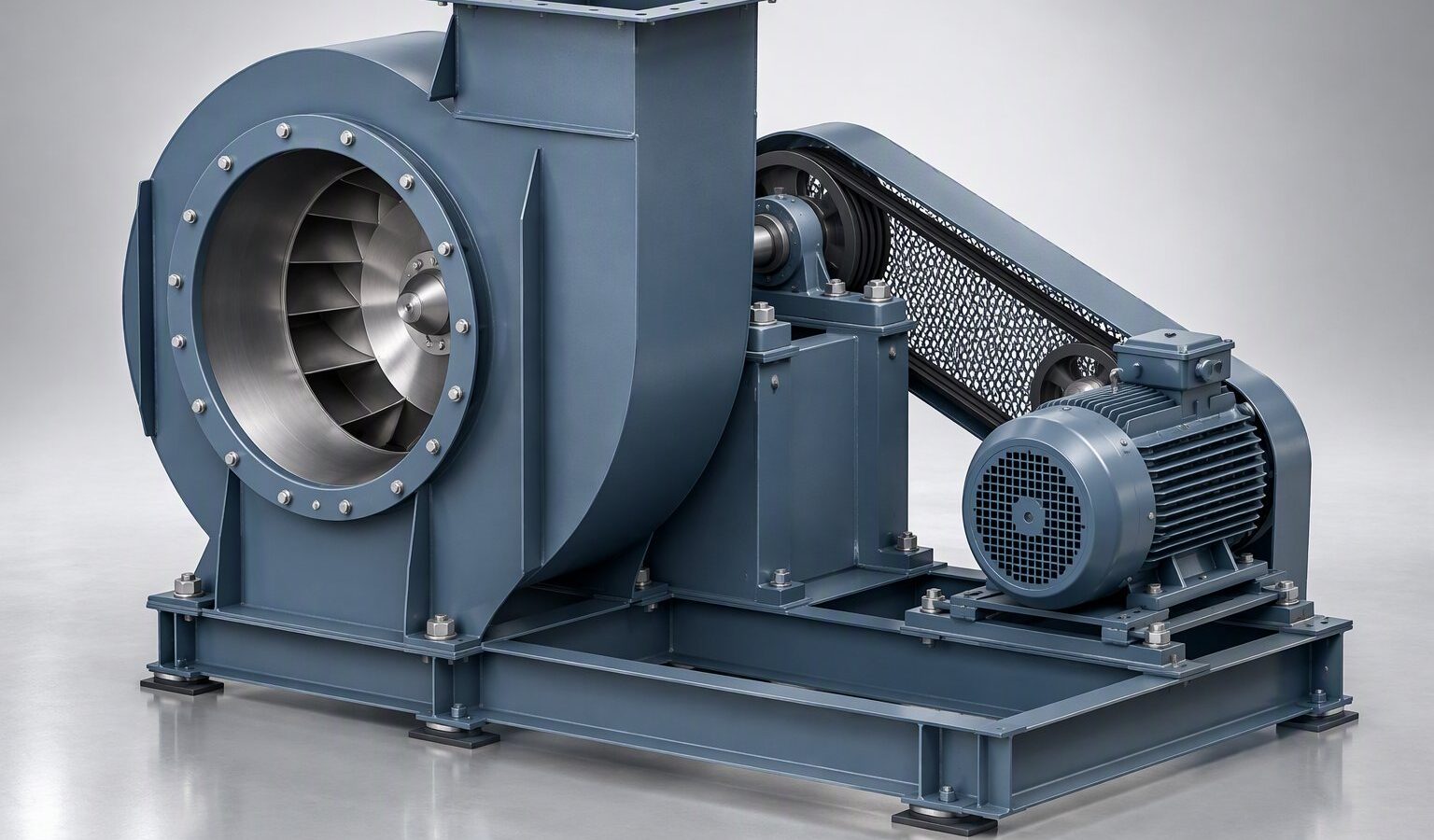
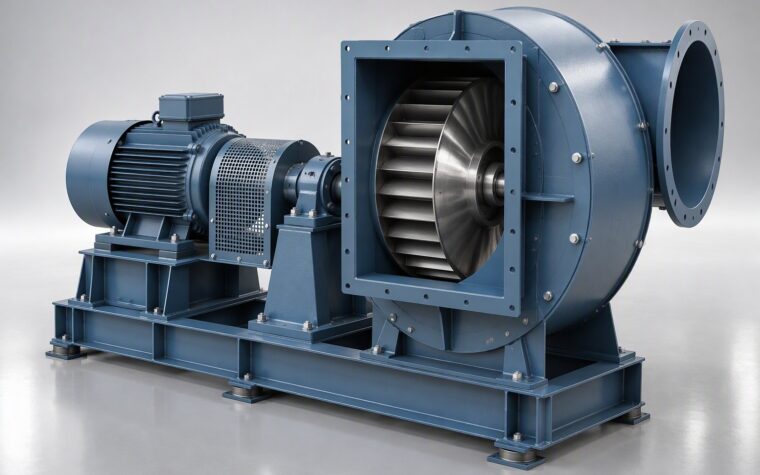
Illustrative 3D render of a backward-inclined centrifugal fan with a belt drive in a perforated guard and a slide-rail mounted motor.

Illustrative 3D render of a representative backward inclined build, not a photograph of a shipped unit.

  • Industrial ventilation and process exhaust
  • Dust collection and bag filter fan service
  • Cyclone and scrubber systems
  • Cement plant auxiliary fans
  • Chemical and fertiliser plant exhaust
  • Combustion and tempering air supply
  • Weld fume and machining mist extraction
Published envelopeBackward Inclined Blower
  • Airflow1,300 to 3,85,000 CMH
  • Static pressure6 to 152 mmWC (published as 0.25 to 6 inWC)
  • DriverMotor sized at the confirmed duty; range-wide 0.5 to 500 HP
  • Gas temperatureUp to 250 C
  • Impeller / frameImpeller 250 to 2,200 mm (range-wide)
  • Speed300 to 4,500 RPM (range-wide)
  • Materials of constructionMild steel, CS SA516 Gr.70, SS 304/304L, SS 316/316L, SS 410, hard-faced edges
  • ArrangementsArrangements 1, 3, 4, 7, 8, 9 - direct and belt drive, SWSI and DWDI
  • Design standardsISO 9001:2015 works; rotor to ISO 1940-1 G6.3, G2.5 on tight duties
  • Test codeIS 4894 (BIS); ISO 5801 / ANSI-AMCA 210 certified rating on request
  • Approx. weightOn the GA drawing for your size
  • WheelBackward inclined flat-plate blades welded to backplate and ring
  • CasingWelded plate, side and top inspection doors
  • InletCone, damper or both
  • DriveDirect or belt, guard and base to your standard
  • WearHard-facing on blade leading edge and inlet ring on request
  • FinishPrimer plus industrial top coat

Ranges are the family envelope our own product pages publish. The order always confirms against an approved GA drawing with the duty point, speed and absorbed power for your installation.

Selection logic

The dust-tolerant member of the backward family

A backward inclined wheel is a set of flat plates, angled backward from the direction of rotation and welded between a backplate and a front ring. There is no curved passage to erode into a shallow scoop, no thin airfoil section to punch through. That single geometric fact is why this wheel ends up on so many exhaust fans in Indian industry: it keeps making pressure after the dust has been at it for a season.

The published envelope for our build is 1,300 to 3,85,000 CMH at 0.25 to 6 inWC static – about 6 to 152 mmWC – with gas to 250 C. Efficiency stays high for a robust wheel and the power curve keeps its non-overloading shape, so an operator opening a damper cannot burn the motor out.

Rebuild, not replace

A welded plate wheel can be scraped, hard-faced and put back in service. When the fan is on a shutdown clock that matters more than two points of efficiency.

Build

Construction

Blades
Flat plate, backward inclined, welded to backplate and front ring
Balance
ISO 1940-1 G6.3 as standard; G2.5 where speed or size demands it
Casing
Welded mild steel or stainless, with inspection access and drain
Wear protection
Hard-facing on leading edges and inlet ring for abrasive loads
Arrangements
1, 3, 4, 7, 8, 9, SWSI and DWDI
Test
IS 4894 performance and run test; certified lab rating to ISO 5801 or ANSI-AMCA 210 when the project requires it

Duty fit

Where it wins

Choose it when the gas is dirty enough to hurt a curved wheel but not so heavy that only a radial blade will survive: cement plant auxiliary duty, weld fume, machining mist, bag filter and cyclone service after the primary arrester, chemical and fertiliser plant exhaust, dryer off-gas. It is also the sane choice on a retrofit where the existing base, belt and motor must be reused.

Where the pressure demand is above roughly 150 mmWC, or the conveying line is long, we move you up to the high pressure radial blade. Where the gas is genuinely clean and the running hours are high, the backward curved wheel earns back its extra cost in electricity.

Send us these and we can quote the same day

  • Dust load in kg per hour and g per cubic metre
  • Particle size range and hardness
  • Bulk density and moisture
  • Whether the fan runs continuous or on a timer

Range

Against the neighbours

Compare the range on one sheet
ParameterBackward Inclined BlowerBackward Curved BlowerIndustrial Exhauster Radial Shrouded Blower
Airflow1,300 to 3,85,000 CMH14,000 to 7,50,000 CMH400 to 1,50,000 CMH
Static pressure6 to 152 mmWC (published as 0.25 to 6 inWC)40 to 2,000 mmWC100 to 2,000 mmWC
Gas temperatureUp to 250 CUp to 200 CUp to 200 C on this build; higher tiers by arrangement
Impeller / frameImpeller 250 to 2,200 mm (range-wide)Impeller 250 to 2,200 mm (range-wide)Impeller 250 to 2,200 mm (range-wide)

Blank cells mean the figure is not published for that family — ask us and we will confirm it against your duty.

Questions

Backward inclined fan - questions

Backward inclined or backward curved for dust collection?

Inclined, in most cases. The flat blade resists erosion better and can be hard-faced and rebuilt. Curved wins where the air is clean and the fan runs 8,000 hours a year, because the efficiency gap shows up on the electricity meter.

Why is the pressure published in inches of water column?

Because that is how our own product data is written for this family. 0.25 to 6 inWC is about 6 to 152 mmWC. We will restate the duty in whichever unit your system designer uses.

Can you match an existing inclined fan on a replacement?

Yes – send the nameplate, a photo of the base and the discharge orientation. We match the duty and the footprint, then confirm absorbed power against your existing motor before anything is cut.

What we need to quote this type

  • Airflow and static pressure at the duty
  • Dust load, particle size and hardness
  • Gas temperature and chemistry
  • Density basis if altitude or temperature is unusual
  • Arrangement, rotation and discharge angle
  • Motor availability and supply, 415 V 3-phase 50 Hz standard

Check the duty point first

Airflow and pressure are always quoted at the actual gas density. Altitude, temperature and duct losses move the number — run it through the worksheet before you send it.

Open the sizing calculator

Other types in this range

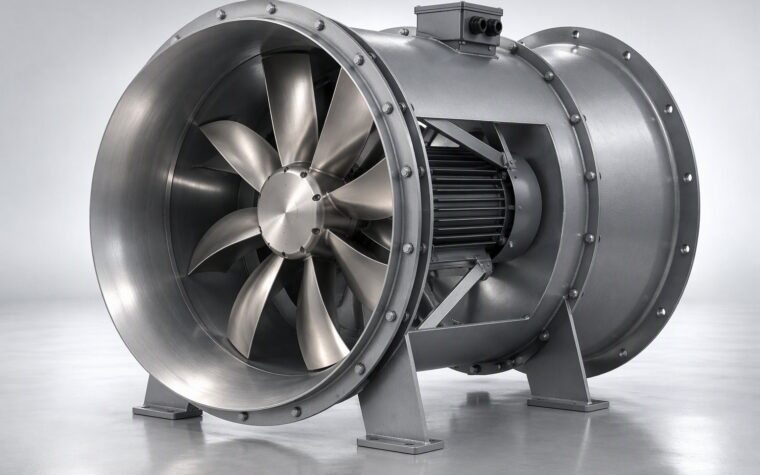
Axial Flow Fan

Straight-through air at low pressure: tube axial, vane axial and propeller builds in mild steel and aluminium.

AirflowDuty specific - confirm the operating point with us
Static pressureLow pressure service, below about 50 mmWC; above that we go centrifugal
See the build sheet

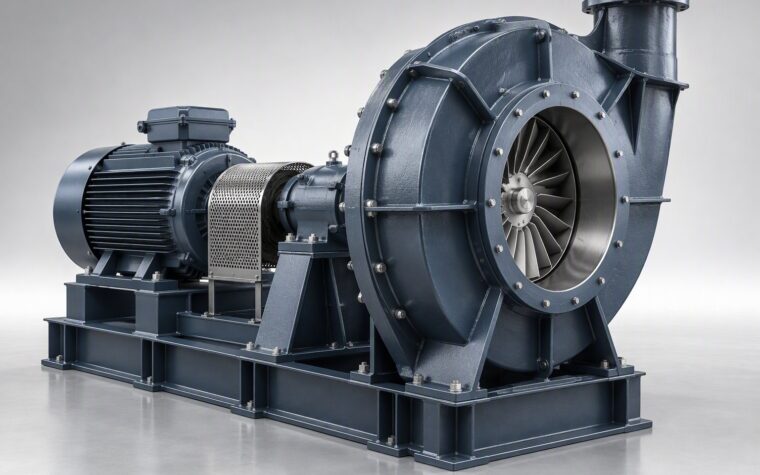
Backward Curved Blower

High static efficiency, non-overloading power curve. The default wheel for clean and lightly loaded air at medium to high pressure.

Airflow14,000 to 7,50,000 CMH
Static pressure40 to 2,000 mmWC

See the build sheet

Enquiry

Send the duty for a backward inclined fan

Tell us the duty and the constraints. You get a selection, a build sheet and a price from the works — not a call centre.

Backward Inclined Blower enquiry

Airflow, static pressure and gas temperature are enough to start. Add a drawing if you have one.

No drawing? The nameplate or a photo of the installation is enough to start.

Urgent? (+91) 990 903 3851

Sent from /blowers/backward-inclined-blower/. Submissions are stored in WordPress and emailed to our estimation desk.

Call the works Enquire