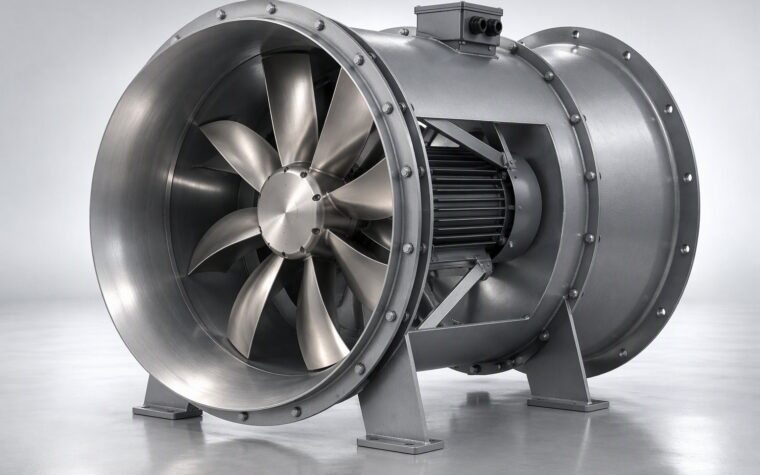
Axial Flow Fan
Straight-through air at low pressure: tube axial, vane axial and propeller builds in mild steel and aluminium.
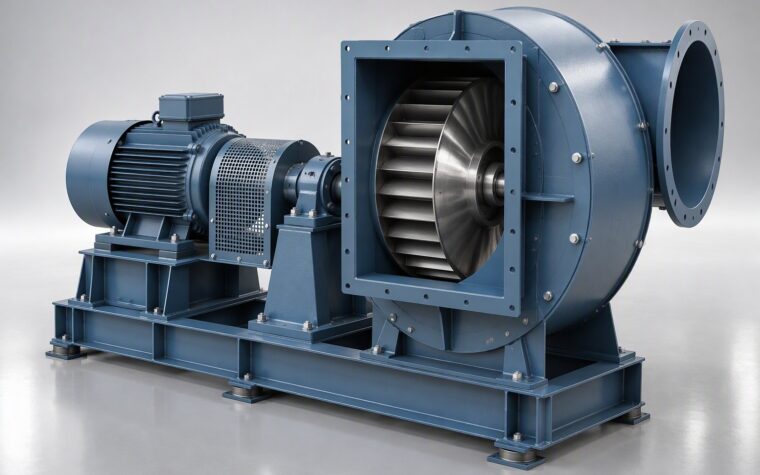
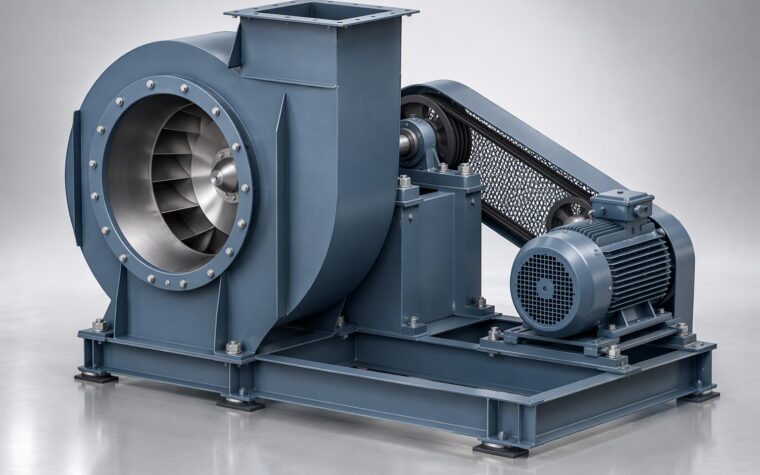
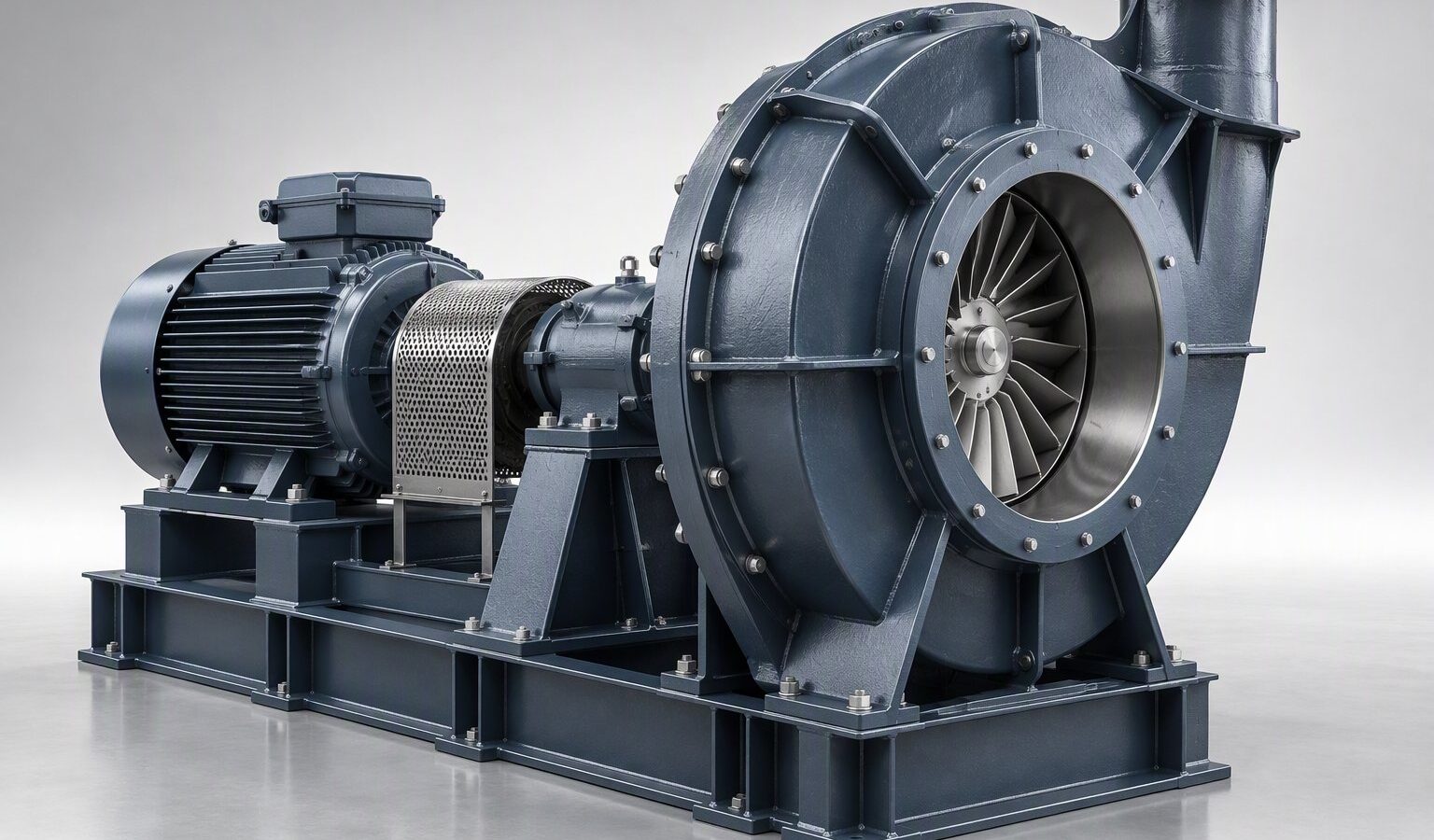
Centrifugal blower - radial blade, PH type
When the duty is pressure and dust rather than efficiency. Straight radial blades carry the product, not scrape it, and they hold their shape at 2,000 mmWC. This is the wheel we reach for on conveying lines and abrasive exhaust.

Illustrative 3D render of a representative radial blade build, not a photograph of a shipped unit.
Ranges are the family envelope our own product pages publish. The order always confirms against an approved GA drawing with the duty point, speed and absorbed power for your installation.
Selection logic
Radial blades run straight out from the hub, perpendicular to the direction of rotation. They do not have the elegance of a curved passage and they will not win an efficiency contest. What they do is build pressure, tolerate being fed product directly into the eye, and survive the abuse. That is why this is the wheel on a pneumatic conveying line, an ash handling system or a cement plant dust hood.
Published envelope: 400 to 1,50,000 CMH at 100 to 2,000 mmWC, gas to 200 C, PH type construction, arrangements 1/9, 4, 7 and 8. Our range ceiling on static pressure, 2,000 mmWC, is set by this family.
Build
Duty fit
On a dilute phase line the fan is a pressure machine with a velocity constraint. Product has to stay airborne – roughly 18 to 35 m/s in the conveying line for most materials – and the pressure has to cover the whole system, not the nominal drop across the filter. Give us the material, the throughput and the travel distance and the sizing comes out of those two numbers.
On a dust collection duty after cyclones, the same wheel handles the residual load that the primary arrester missed. If the load is genuinely heavy and the plant wants efficiency, the honest answer is a two-stage approach: arrester first, then a smaller fan.
Vacuum and pressure phase, dilute phase designs, 18 to 35 m/s line velocity and up to 1.0 bar(g) on the pressure side.
Range
| Parameter | High Pressure Radial Blade Blower | Backward Curved Blower | Industrial Exhauster Radial Shrouded Blower |
|---|---|---|---|
| Airflow | 400 to 1,50,000 CMH | 14,000 to 7,50,000 CMH | 400 to 1,50,000 CMH |
| Static pressure | 100 to 2,000 mmWC | 40 to 2,000 mmWC | 100 to 2,000 mmWC |
| Gas temperature | Up to 200 C | Up to 200 C | Up to 200 C on this build; higher tiers by arrangement |
| Impeller / frame | Impeller 250 to 2,200 mm (range-wide) | Impeller 250 to 2,200 mm (range-wide) | Impeller 250 to 2,200 mm (range-wide) |
Blank cells mean the figure is not published for that family — ask us and we will confirm it against your duty.
Questions
A well designed backward curved wheel reaches up to 85% static efficiency in our range documentation. A radial wheel trading that for erosion resistance and pressure is normal engineering. On a continuous 8,000 hour duty the electricity argument is real; on an intermittent conveying duty the metal argument wins.
Yes, and we will tell you where. Blade tips, inlet ring and cutwater are the three places dust does its work. Specify the material and we will state the process on the build sheet.
To 200 C on this wheel. Above that, look at the high temperature plug blower, where bearing isolation and thermal growth are designed in rather than explained away.
Airflow and pressure are always quoted at the actual gas density. Altitude, temperature and duct losses move the number — run it through the worksheet before you send it.
Straight-through air at low pressure: tube axial, vane axial and propeller builds in mild steel and aluminium.
High static efficiency, non-overloading power curve. The default wheel for clean and lightly loaded air at medium to high pressure.
Flat plates set at an angle: robust, tolerant of moderate dust, still efficient and still non-overloading.
Enquiry
Tell us the duty and the constraints. You get a selection, a build sheet and a price from the works — not a call centre.