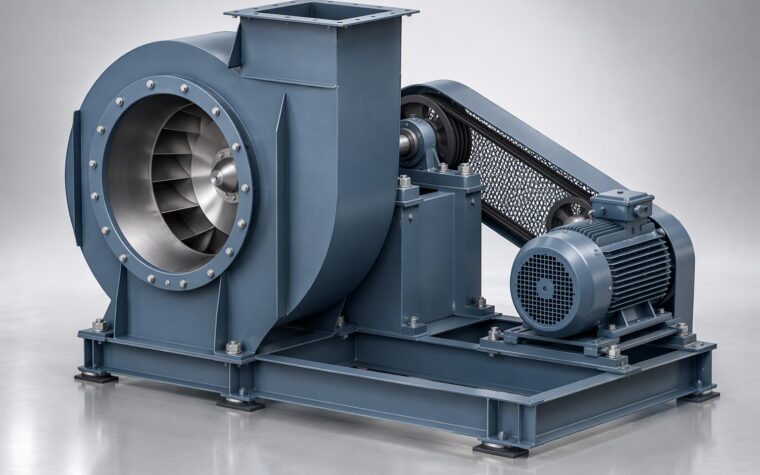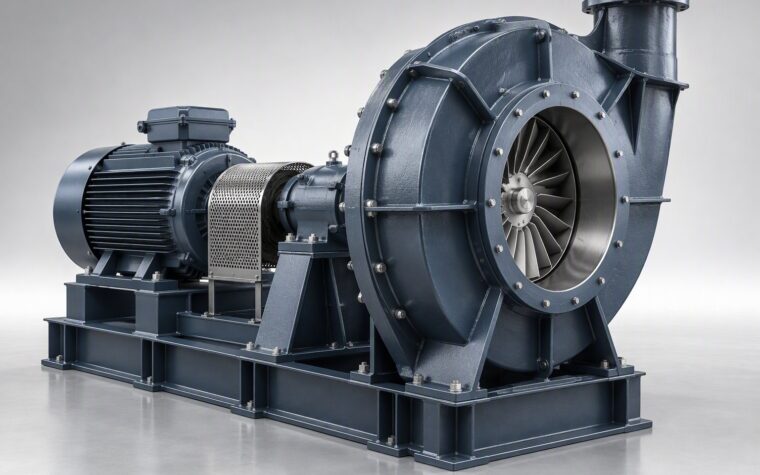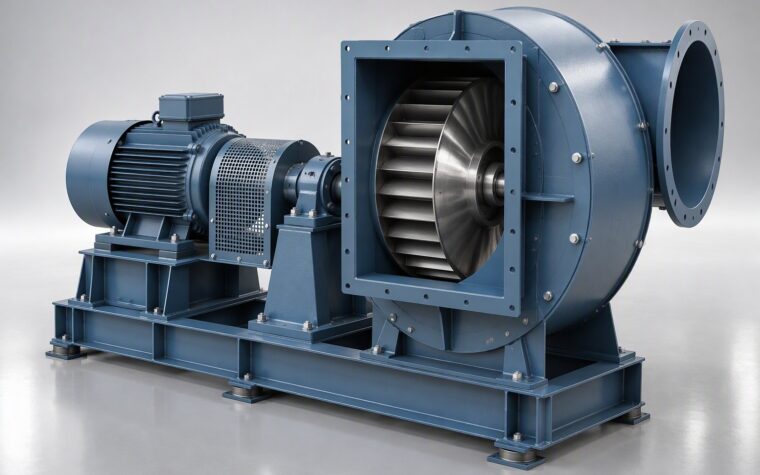
Backward Curved Blower
High static efficiency, non-overloading power curve. The default wheel for clean and lightly loaded air at medium to high pressure.
Airflow14,000 to 7,50,000 CMH
Static pressure40 to 2,000 mmWC
Axial fans - straight-through air
When the resistance is low and the volume is high, a centrifugal machine is the wrong tool. Axial fans push air straight through a barrel, take almost no floor space and cost less to install. They also stop working the moment the duct fights back.
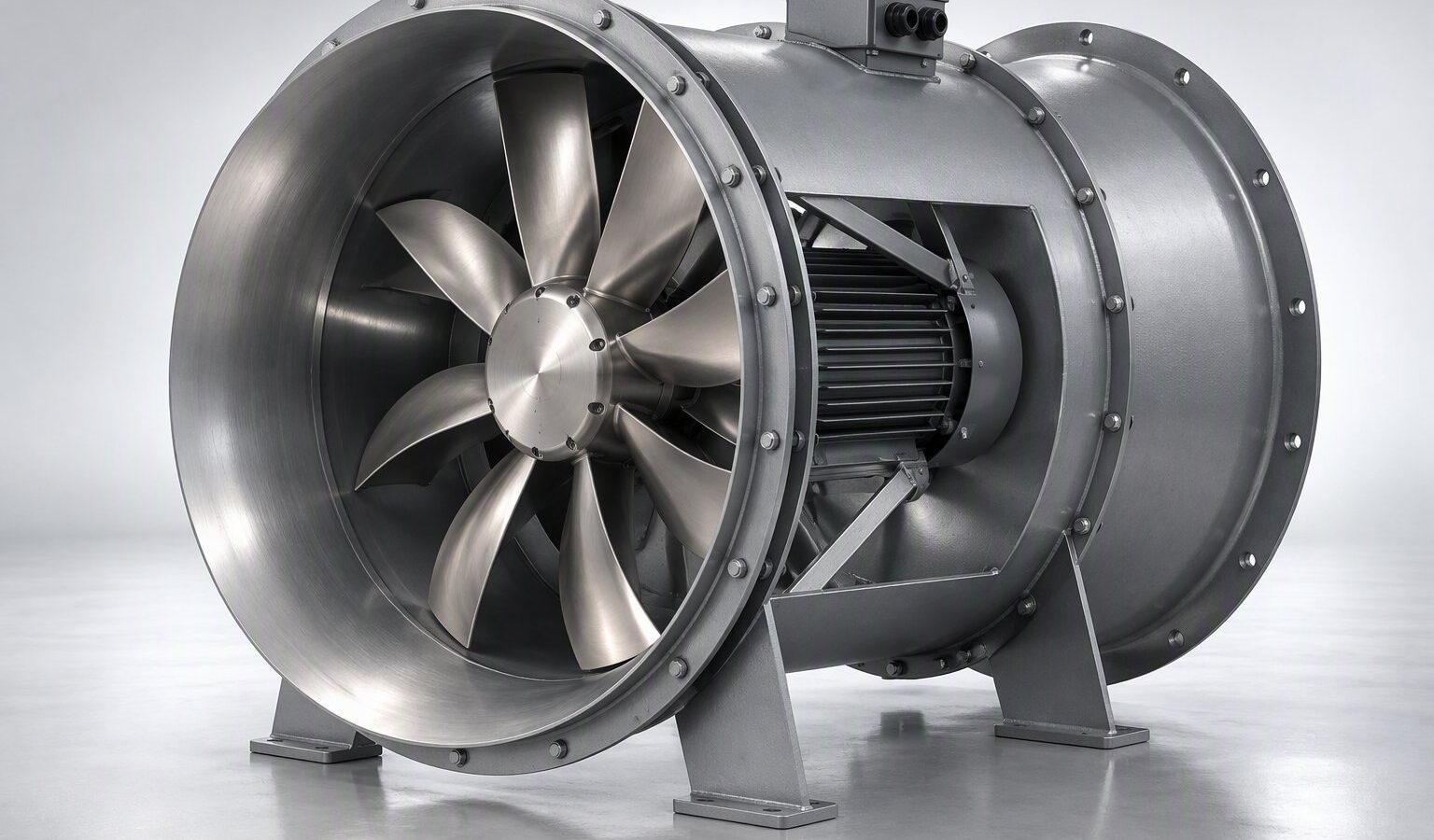
Illustrative 3D render of a representative axial fan build, not a photograph of a shipped unit.
Ranges are the family envelope our own product pages publish. The order always confirms against an approved GA drawing with the duty point, speed and absorbed power for your installation.
Selection logic
Our own range documentation draws the line plainly: axial fans sit below roughly 50 mmWC, centrifugal machines carry the duty from there up to 2,100 mmWC. That single number decides most conversations. Below it, an axial fan is cheaper, smaller and simpler than anything else. Above it, an axial fan will stall, howl and fail to deliver.
We do not publish an airflow envelope for this family on our product pages, because axial performance depends on blade pitch, tip speed and duct conditions in a way that no honest catalogue range captures. We quote it from your duty point and we show you the curve.
Types
Open wheel on a frame. Cheapest, quietest option for wall and roof extraction against almost no resistance.
Propeller inside a barrel: the casing recovers some of the swirl and lifts the pressure a little.
Tube plus downstream straightening vanes. The way to get real static out of an axial machine.
Aerofoil blades, higher pressure capability, motor in the airstream or out of it by design.
Duty fit
Good. Building and basement ventilation, workshop and shed extraction, cooling tower and heat exchanger air movement, tunnel and enclosed space ventilation, dilution and purge duty – anything that is volume against low resistance.
Bad. Dust collection, conveying, filter service, long ducts, anything with a real pressure drop. Those are centrifugal duties and the wrong fan there will be blamed on the plant instead of the selection.
Fan noise tracks the fifth power of tip speed. Halving the speed buys about 15 dB, which is why a large slow axial is often the quiet answer on a site with a boundary limit.
Range
| Parameter | Axial Flow Fan | Industrial Exhauster Air Handling Blower | Backward Curved Blower |
|---|---|---|---|
| Airflow | Duty specific - confirm the operating point with us | 1,750 to 2,30,000 CMH | 14,000 to 7,50,000 CMH |
| Static pressure | Low pressure service, below about 50 mmWC; above that we go centrifugal | 25 to 406 mmWC (published as 1 to 16 inWC) | 40 to 2,000 mmWC |
| Gas temperature | Confirm gas temperature at enquiry | Up to 200 C | Up to 200 C |
| Impeller / frame | Barrel and blade diameter by duty | Impeller 250 to 2,200 mm (range-wide) | Impeller 250 to 2,200 mm (range-wide) |
Blank cells mean the figure is not published for that family — ask us and we will confirm it against your duty.
Questions
Because we will not publish a number we have not earned. Axial performance moves with blade pitch, tip speed and the duct around it, and the honest answer comes from your duty point and a curve, not a range table.
Only light, dry, non-abrasive carryover. If the air is carrying product, the blades are a wear item and the efficiency is irrelevant – go centrifugal.
We supply the fan; the drive is usually owned by the plant. Speed control is the right partner for an axial machine, because flow follows speed almost linearly while power falls as the cube.
Airflow and pressure are always quoted at the actual gas density. Altitude, temperature and duct losses move the number — run it through the worksheet before you send it.
High static efficiency, non-overloading power curve. The default wheel for clean and lightly loaded air at medium to high pressure.
Flat plates set at an angle: robust, tolerant of moderate dust, still efficient and still non-overloading.
Straight radial blades, PH type: the wheel for conveying pressure, abrasive dust and long lines.
Enquiry
Tell us the duty and the constraints. You get a selection, a build sheet and a price from the works — not a call centre.