Axial Flow Fan
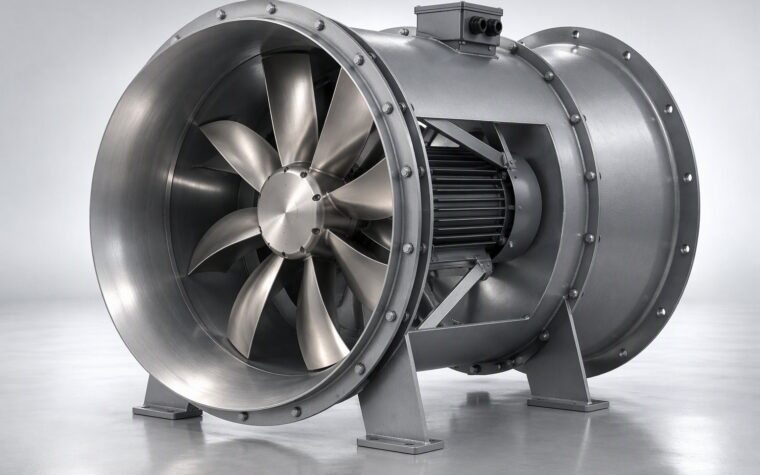
Straight-through air at low pressure: tube axial, vane axial and propeller builds in mild steel and aluminium.
Centrifugal blower - backward curved wheel
The workhorse for ventilation and process air where the gas is clean or lightly loaded and the electrician cares about the power curve. Backward curved wheels give up to 85% static efficiency with a non-overloading characteristic, so the motor does not grow with the duct.

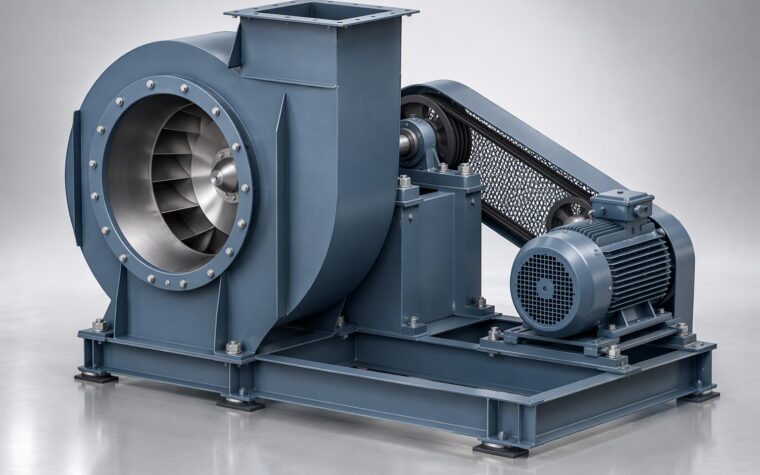
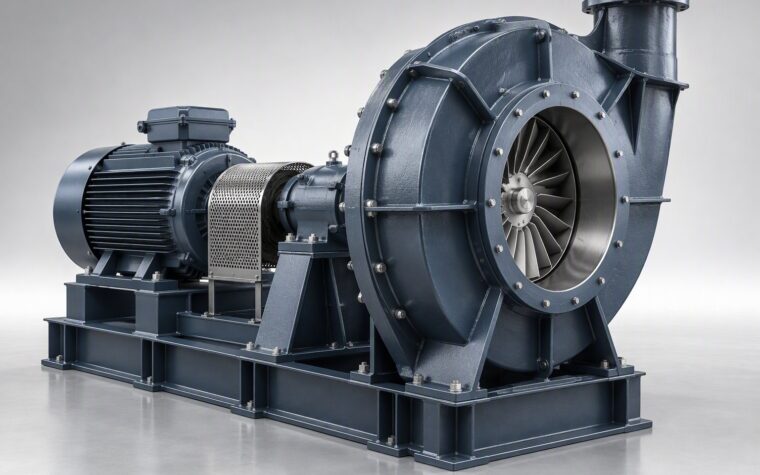
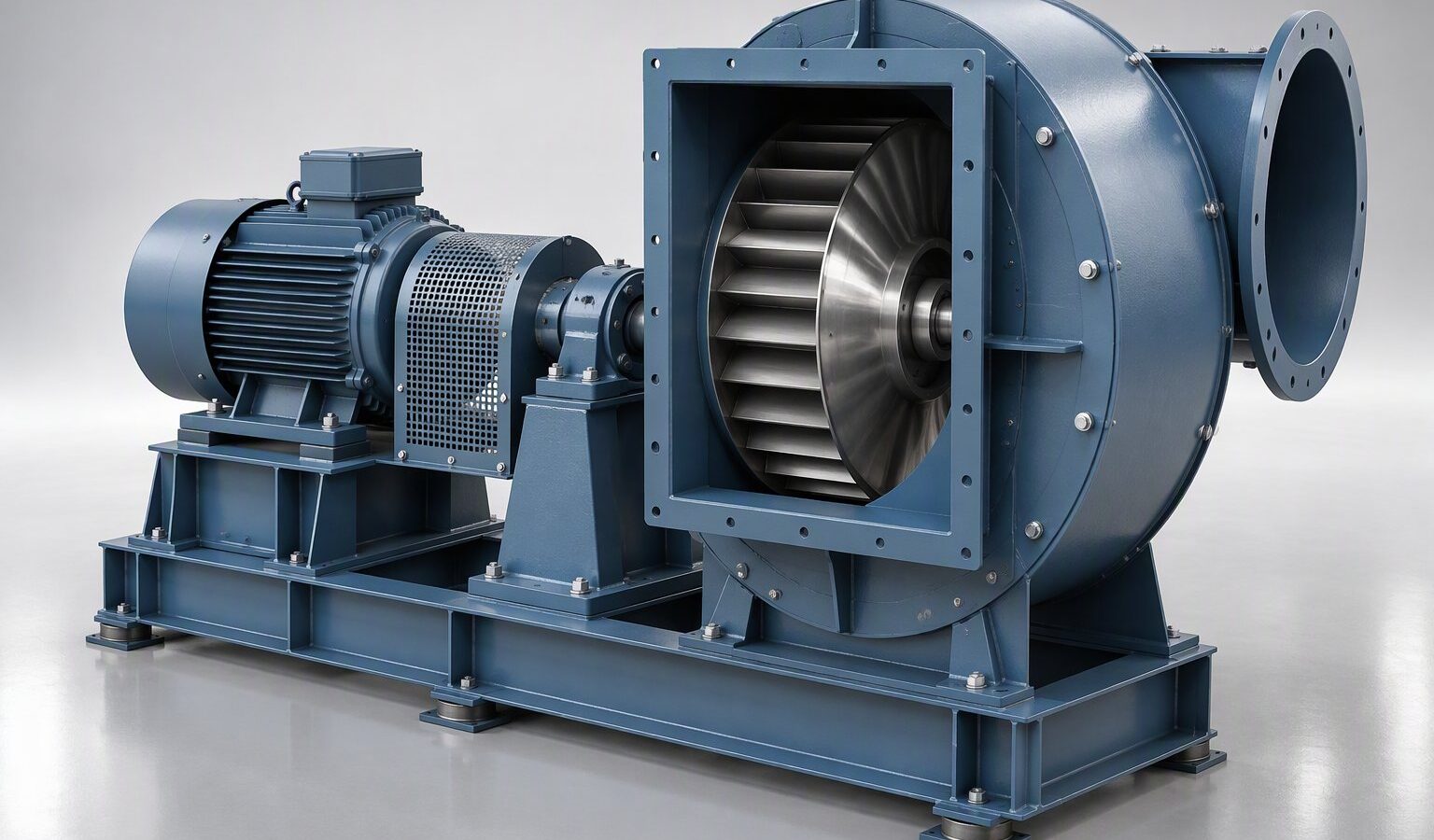
Illustrative 3D render of a representative backward curved build, not a photograph of a shipped unit.
Ranges are the family envelope our own product pages publish. The order always confirms against an approved GA drawing with the duty point, speed and absorbed power for your installation.
Selection logic
Backward curved blades leave the wheel moving against the direction of rotation. The result is the highest static efficiency of the centrifugal family and, more usefully on a live plant, a power curve that rises to a peak and then falls. Open the damper on a backward curved fan and the motor does not keep climbing. On a radial blade fan it can.
That characteristic is why this wheel is the default for ventilation, filter service and process air where the gas is clean or only lightly loaded, and where the fan runs against a throttling system. Our published envelope for the type is 14,000 to 7,50,000 CMH at 40 to 2,000 mmWC, to 200 C, in single or double inlet.
At the same duty as a forward curved wheel, the backward curved fan usually runs slower and smaller. The fan law is unforgiving: absorbed power goes as the cube of speed, so the slower wheel is the cheaper one to run for twenty years.
Build
Duty fit
Good fit. Clean air and lightly dusty gas: building and plant ventilation, bag filter clean-side exhaust, scrubber and oxidiser supply, pneumatic conveying of light non-abrasive product, dryer and process hood exhaust, combustion air on small burners, pharmaceutical and food process air where the wetted metal is stainless.
Poor fit. Heavy or abrasive dust. Blade-leading-edge wear on a backward curved wheel is real, and once the profile changes the fan stops making its pressure. If the gas carries more than a light load, or carries chips, we move you to a radial blade or an exhauster wheel and trade efficiency for metal thickness and hard-facing. Send us the dust data and we will show you both options in writing.
Clean-side exhaust is this wheel in its element: steady flow, moderate pressure, gas below 200 C and no solids worth counting.
Range
| Parameter | Backward Curved Blower | Backward Inclined Blower | High Pressure Radial Blade Blower |
|---|---|---|---|
| Airflow | 14,000 to 7,50,000 CMH | 1,300 to 3,85,000 CMH | 400 to 1,50,000 CMH |
| Static pressure | 40 to 2,000 mmWC | 6 to 152 mmWC (published as 0.25 to 6 inWC) | 100 to 2,000 mmWC |
| Gas temperature | Up to 200 C | Up to 250 C | Up to 200 C |
| Impeller / frame | Impeller 250 to 2,200 mm (range-wide) | Impeller 250 to 2,200 mm (range-wide) | Impeller 250 to 2,200 mm (range-wide) |
Blank cells mean the figure is not published for that family — ask us and we will confirm it against your duty.
Questions
No. Backward curved blades are swept in one continuous curve, usually with more blades and a smaller passage; backward inclined blades are flat plates set at an angle, simpler to build and more tolerant of moderate dust. The curved wheel is generally the more efficient of the two, the inclined wheel the more robust and easier to repair. We quote both against the same duty so you can see the efficiency-versus-wear trade.
Our pages quote static pressure in mmWC, measured as fan total pressure less the outlet velocity pressure, at the actual gas density. Tell us the reference plane you are working to and we will restate the number so both curves line up.
To 200 C as standard for this wheel. Above that the choices change: thermal expansion in the casing, shaft growth, bearing isolation, and the material grade. For hot gas we move to a high temperature or plug design and cool or isolate the bearings.
Direct (arrangements 1 and 3) is simpler, loses no belt power and needs no belt maintenance. Belt (4, 7, 8, 9) lets you trim speed at commissioning and keeps the motor out of the hot or dusty air stream. On retrofits, belt drive often wins because it lets the plant keep the existing base and motor.
Airflow and pressure are always quoted at the actual gas density. Altitude, temperature and duct losses move the number — run it through the worksheet before you send it.
Straight-through air at low pressure: tube axial, vane axial and propeller builds in mild steel and aluminium.
Flat plates set at an angle: robust, tolerant of moderate dust, still efficient and still non-overloading.
Straight radial blades, PH type: the wheel for conveying pressure, abrasive dust and long lines.
Enquiry
Tell us the duty and the constraints. You get a selection, a build sheet and a price from the works — not a call centre.